From Draft to Deed: When AI Starts Pressing Buttons
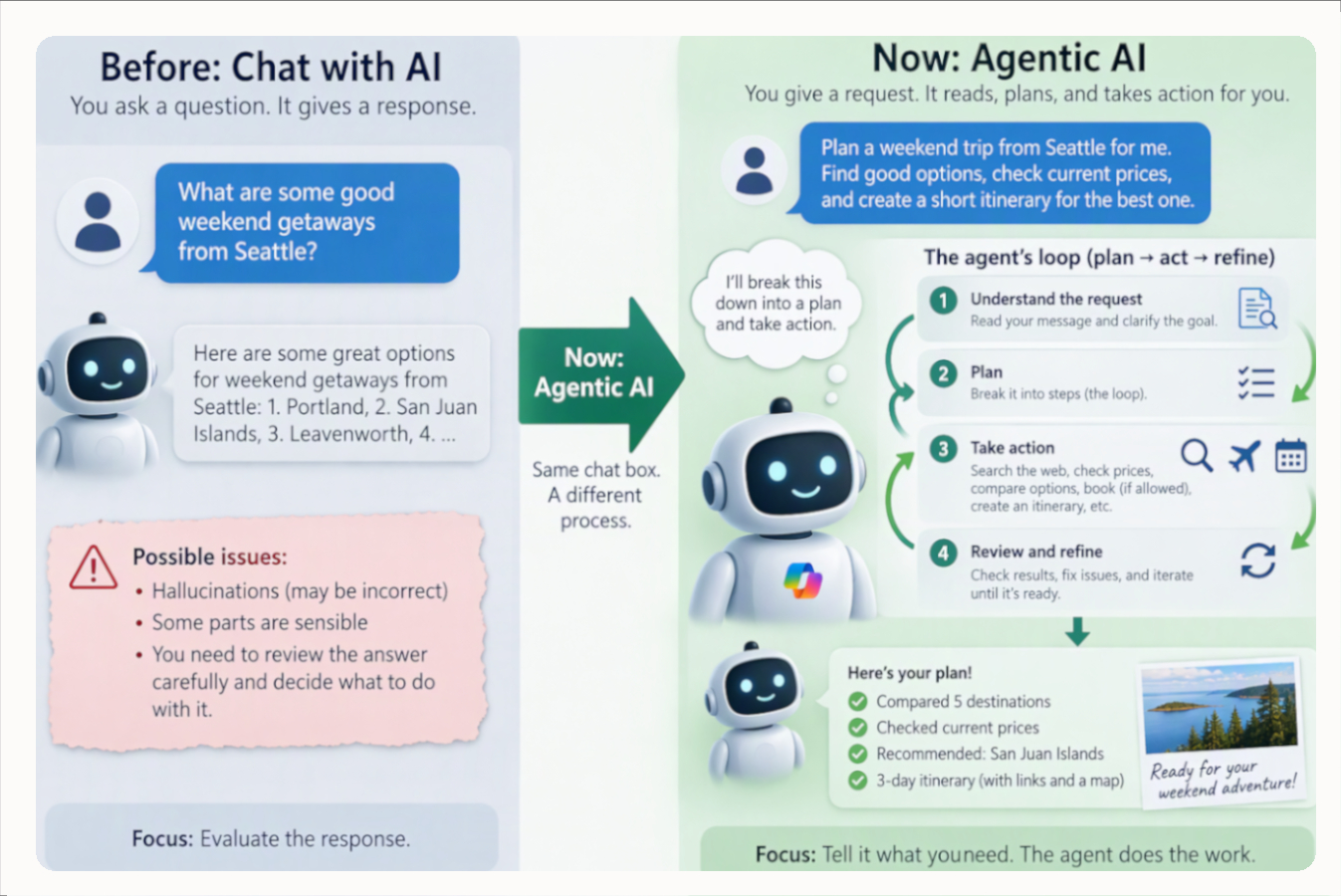
image courtesy of ChatGPT - prompt author
The Age of the Chat Box
For a brief, curious season, we interacted with artificial intelligence almost entirely through a single rectangle on a screen. We typed a question or an instruction, and the machine replied, fluently and confidently, and not always correctly. The exchange had the rhythm of correspondence: a message sent, a message received, and a pause in which the human reader decided what to make of it.
That pause mattered more than we perhaps appreciated. The responses were imperfect, and everyone who used these systems learned that imperfection. Some passages were lucid and useful. Others were fabrications delivered in the same assured cadence: invented citations, plausible but non-existent facts, reasoning that wandered quietly off the path. We named this tendency "hallucination," a term at once clinical and strangely poetic, and we built our habits of use around it. The discipline of the era was one of careful reading. We reviewed what the model produced, separated the sound from the spurious, and only then decided what to do with the result.
Throughout, a quiet safeguard was in place. The model could speak, but it could not act. Whatever it said remained words on a screen until a human being chose to carry them into the world. The person stood between the output and its consequences, a sentinel at the threshold. Error was therefore an inconvenience, sometimes an embarrassment, but rarely a catastrophe.
A Different Kind of Exchange
Then came a development that has been given the name agentic AI. It is worth being precise about what changed, because the novelty is easily overstated or misunderstood. Agentic AI did not abolish the chat box. The familiar rectangle remains, and we still type our requests into it. What has changed is the nature of the process that now unfolds behind it.
An agentic system does not merely reply. It acts on our behalf. The model reads what we have written and, rather than composing an answer, formulates a plan to fulfil the request. That plan is commonly called a loop, and the term is apt. Within the loop, the model may reach for tools: it may search, retrieve, calculate, write to a file, query a database, or dispatch a message. It then reviews what it has done and judges whether the objective has been met. If it has not, the model returns to the beginning of the loop and tries again, adjusting its approach, and continues until it concludes that the task is complete.
It is a graceful architecture, and one with a certain intuitive logic. It resembles the way a diligent colleague works: considering the assignment, taking a step, inspecting the result, and correcting course. It is little wonder that the idea has stirred such enthusiasm among those who imagine the tedium of knowledge work finally delegated.
Yet the most clarifying way to understand the change is also the most modest. Agentic AI does not replace generative AI. It is generative AI that has been allowed to press buttons. The same underlying engine, with the same strengths and the same susceptibilities, has been granted a new faculty: the ability to reach beyond the conversation and touch the world.
The Measure of a Shift
It is tempting to treat this as an incremental refinement, one more feature in a rapidly expanding catalogue. But a notable shift deserves a sober measure, and the question worth asking is a simple one: how substantial is it, really?
Consider what the chat-box era asked of us. When a model hallucinated, the error lived inside a document or a paragraph, and our task was to notice it. The failure was contained within the text, and the human reader was the firewall. A fabricated reference might embarrass an author who failed to check it, but it harmed no one until it was repeated.
Now consider the same flaw inside a loop. A hallucination no longer merely misleads; it may execute. A misread instruction, an invented detail, or a confident misjudgment of the task's success can translate directly into an email dispatched to the wrong recipient or a refund issued to the wrong account. Such actions are not paragraphs to be corrected. They are events that have already occurred, and they may be difficult or impossible to retract.
Compounding the matter is the structure of the loop itself. A single erroneous step can be caught and corrected by a vigilant reader. But an agent working through a sequence of tasks builds each action upon the last, and an early misjudgment may be carried forward and magnified through every subsequent step. Moreover, the agent is the one assessing whether it has met its objectives. The same faculty that produced the error is asked to evaluate it, and a model that is mistaken in its reasoning may be equally mistaken in its verdict on that reasoning. The loop offers the comfort of self-correction, but it cannot guarantee it. The outcome of a series of autonomous actions cannot be truly assured in advance, and when the flaws of the system were once confined to words, they now extend into deeds.
The Vanishing Sentinel
What troubles me most, and what I suspect will trouble thoughtful readers in both the academy and the consultancy, is the quiet erosion of the human checkpoint. The great virtue of the chat box was that it kept us in the loop, as the saying goes. Agentic systems promise something different: that we may step back, delegate, and return only when the work is done. The very appeal of the technology, its capacity to relieve us of oversight, is also its principal hazard.
There is a familiar pattern in the history of automation. As systems become more reliable, human attention drifts. We stop reading every output closely because the last hundred were fine. Vigilance, a costly cognitive effort, is the first casualty of apparent competence. An agent that performs well ninety-nine times invites trust on the hundredth, which may be the occasion on which it errs most consequentially. The danger lies not in the system's failure alone but in the gradual relaxation of the scrutiny that once caught such failures.
For consultants, this is not an abstract concern. Those who advise organisations on adopting these tools will increasingly be asked not whether an agent can perform a task, but whether it should be permitted to, and under what conditions. For academics, the questions are equally pressing and perhaps more interesting: how do we study, measure, and reason about the reliability of systems whose behaviour unfolds across many steps and whose errors compound in ways that a single-turn evaluation would never reveal?
Principles for Prudent Delegation
None of this constitutes an argument for retreat. The potential of agentic systems is real, and a profession that declined to engage with them would be abdicating its responsibility to understand them. The wiser course is to meet this capability with the seriousness it deserves. A few principles suggest themselves.
First, match autonomy to consequence. Tasks whose errors are cheap and reversible, such as drafting, sorting, or summarising, may reasonably be delegated with a light touch. Tasks that move money, alter records, or communicate with third parties warrant far greater caution, and in many cases a human approval step before the action is taken.
Second, preserve reversibility wherever possible. Systems should be designed so that mistakes can be undone: drafts rather than sent messages, holds rather than final payments, logs that permit reconstruction of what occurred and why.
Third, constrain the tools as carefully as the task. An agent can only press the buttons it has been given. Limiting the scope of its permissions is among the most effective safeguards available, and it demands no breakthrough in model reliability, only sound institutional discipline.
Fourth, keep a human accountable. No matter how sophisticated the loop, responsibility for its actions cannot be delegated to the model. Someone must own the outcome, and that ownership should shape how the system is deployed from the outset.
A Closing Reflection
There is a certain poetry in the trajectory we have traced. We began by conversing with a machine that could only speak, and we learned to read its words with a critical eye. We now converse with a machine that can act, and we must learn to govern its deeds with an equally critical, and considerably more careful, hand.
The shift from generative to agentic AI is not a change of kind so much as a change of stakes. The flaws remain what they always were: the occasional fabrication, the confident misstep, the plausible error. But a flaw that once lived harmlessly in a paragraph may now live in an action, and the difference between the two is the difference between a draft and a deed.
The invitation, then, is to embrace this technology with open eyes and measured expectations. If agentic AI is indeed generative AI that has been allowed to press buttons, then our task is to decide, with wisdom and with some humility, which buttons we are prepared to let it press.
Watch The Video